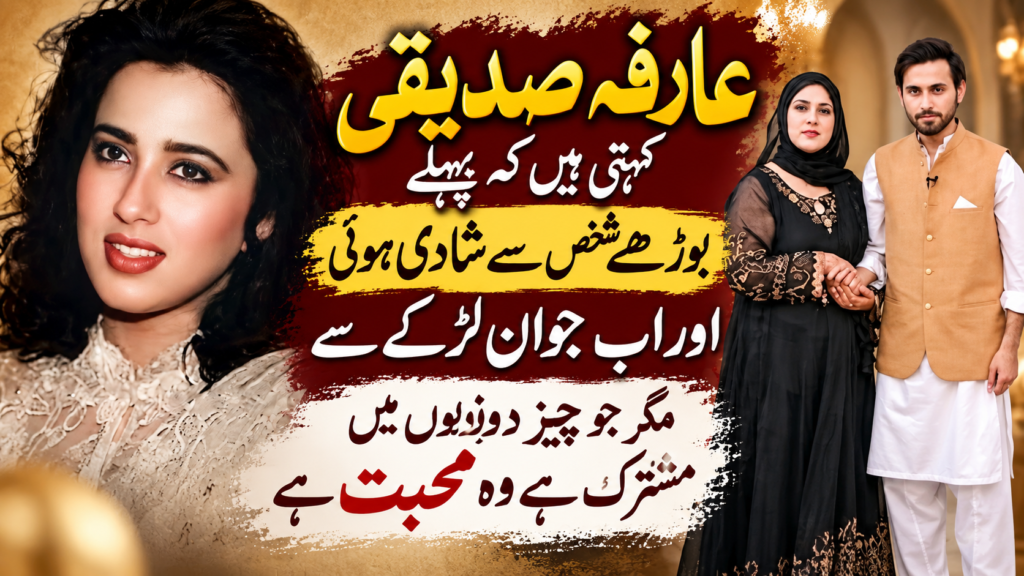
Pakistani actress and singer Arifa Siddiqui has lived a life that has often challenged conventional expectations. From her successful career in television and music to her personal choices, she has remained a familiar name for audiences who remember the golden era of Pakistan Television.
Her marriages, in particular, have attracted considerable public attention because of the significant age differences involved. Arifa first married a man considerably older than herself and, years later, began a new chapter of her life with a younger partner.
While people may focus on the difference in ages, Arifa’s perspective presents a much simpler idea: age may change, circumstances may change, but love and understanding can remain at the heart of a relationship.
Arifa Siddiqui’s Journey in Pakistani Showbiz
Arifa Siddiqui became known to Pakistani audiences through television, acting and music. Her distinctive personality and artistic abilities helped her establish a place in the entertainment industry.
Unlike many celebrities who remain continuously in the spotlight, Arifa eventually stepped away from much of mainstream showbiz. However, public interest in her life did not disappear.
Her personal journey became particularly interesting to fans because she made decisions that were considered unusual according to traditional social expectations.
One of those decisions was her first marriage.
Her First Marriage to a Much Older Man
Arifa Siddiqui’s first husband was musician Ustad Nazar Hussain. There was a considerable age difference between the couple, something that naturally became a talking point among the public.
In South Asian society, marriages involving a large age gap often generate discussion. Arifa’s marriage was no exception.
Yet looking only at their ages does not explain the relationship itself. Both were connected to the world of music, giving them an important shared interest.
For Arifa, the relationship appears to have been about far more than numbers on a birth certificate. Companionship, respect, affection and their connection through music formed part of their life together.
Their marriage became an important chapter in her life and lasted until the death of her husband.
Losing a Life Partner
Losing a spouse can completely change the direction of someone’s life. Years of shared memories, everyday routines and companionship cannot simply be replaced.
After the death of Ustad Nazar Hussain, Arifa entered a very different period of her life.
The loss marked the end of one chapter, but it did not mean that she could never begin another.
Eventually, she decided to marry again.
This time, however, the age difference was reversed.
A New Beginning With a Younger Partner
Arifa later married Tabeer Ali, who is younger than her.
The relationship once again attracted public attention because of age—but for exactly the opposite reason.
During her first marriage, people talked about her husband being significantly older than her. In her later relationship, attention shifted to the fact that her partner was younger.
It created an unusual contrast in her life story: first an older husband, then a younger one.
For outsiders, that contrast may seem like the most interesting part of the story. For the people actually living the relationship, however, age may not necessarily be its defining feature.
What Was Common in Both Relationships?
At first glance, Arifa’s two marriages appear very different.
Her first husband was considerably older and belonged to an earlier generation, while her second partner is younger than her. Yet the common thread, according to the way Arifa has spoken about her relationships, is emotional connection and affection.
Love does not always follow society’s expected formula.
People can connect because of personality, shared interests, emotional support, mutual respect and the sense of comfort they find in each other’s company.
Age is certainly a practical factor in a relationship, particularly when the difference is significant. But it is not the only factor that determines why two adults choose to share their lives.
Why Society Focuses So Much on Age
Age differences in marriage have always fascinated people, but society often reacts differently depending on who is older.
A marriage between an older man and a younger woman is relatively common in many cultures. When the woman is considerably older than the man, however, the relationship can receive much greater scrutiny.
Arifa’s story contains both situations.
She has therefore experienced public curiosity from two completely different directions. In one chapter of her life, she was the younger partner. In another, she became the older partner.
The contrast makes her story particularly interesting because it raises a simple question: Should age alone define how we understand a marriage?
Marriage Is More Than an Age Difference
Successful relationships depend on many things.
Trust, communication, respect, emotional compatibility and the ability to support each other during difficult periods can all play major roles. Every couple also faces its own circumstances, which outsiders may never fully understand.
This is why reducing a marriage entirely to an age gap can produce an incomplete picture.
Two people of almost identical ages can have completely different personalities and struggle to understand each other. Meanwhile, two people separated by many years may discover that they share values, interests and a strong emotional connection.
Neither situation guarantees success or failure.
Every relationship has to be understood on its own terms.
Starting Again After Loss
Another important aspect of Arifa Siddiqui’s story is her willingness to begin a new chapter after experiencing the loss of her first husband.
Widowhood is often accompanied by emotional challenges as well as social expectations. For women in particular, remarriage can sometimes attract unnecessary criticism or judgment.
Choosing companionship again does not erase an earlier relationship or the memories associated with it. A person’s past can remain meaningful while they continue moving forward with their life.
Arifa’s journey illustrates how different chapters can coexist within one person’s story.
Her first marriage belonged to one period of her life. Her later relationship represents another.
They do not have to be identical to be meaningful.
From an Older Husband to a Younger Partner
It is easy to turn Arifa Siddiqui’s story into a discussion purely about numbers: How much older was her first husband? How much younger is her current partner?
But those questions can distract from the human side of the story.
Behind every marriage are two individuals making decisions about companionship and their future.
Public figures face an additional challenge because personal decisions that would normally remain within a family can become subjects of national conversation. Photographs, interviews and comments can quickly circulate online, encouraging thousands of strangers to form opinions about relationships they know very little about.
Arifa’s experience demonstrates exactly that phenomenon.
Does Age Really Matter in Love?
There is no universal answer.
A large age gap can bring practical considerations, including differences in health, lifestyle, future plans and life stages. Those issues should not simply be ignored.
At the same time, age alone cannot tell us whether two adults genuinely understand or care about one another.
Relationships are far more complicated than a single number.
For some couples, being close in age is important. Others prioritize shared interests, emotional compatibility or companionship. What works for one marriage may not work for another.
A Life That Refuses to Follow a Formula
Arifa Siddiqui’s personal journey is ultimately about more than marrying an older man and later choosing a younger partner.
It is a story about different stages of life.
She experienced fame, music, marriage, companionship, loss and eventually a new beginning. Each stage brought different circumstances and different choices.
People may continue discussing the unusual age differences surrounding her marriages, but perhaps the more interesting element is that her life did not follow a predetermined formula.
Her experiences also offer a broader reminder about relationships: numbers can describe an age difference, but they cannot fully describe the bond between two people.
In Arifa Siddiqui’s case, the ages and circumstances changed dramatically between the two chapters of her married life. Yet the element she has emphasized goes beyond age—the desire for love, companionship and someone with whom to share life’s journey.